Showing posts with label Burkert. Show all posts

Sunday, March 23, 2014

Crossover ASCO Red-Hat to Burkert Valves

Burkert Advantages/Benefits
  • High quality valves at competitive prices
  • A wide variety of valves available to choose from in order to fulfill your application requirements.
  • Burkert offers standards that would cost you extra elsewhere
  • First rate customer Service
  • Better delivery on custom items
  • UL, UR, CSA, FM, CGA,CE, ATEX approvals and more


ASCO® Red–Hat® to Burkert Crossover Guide

Please read this page thoroughly before continuing.
 
The following crossover list is a recommendation of Burkert valves that are similar to the operation and specifications of the ASCO® valves. In many cases the Burkert valve may exceed ASCO's® specifications and in some cases it may not. Below are several rules to follow when specifying a Burkert valve to replace an existing ASCO® valve.

1. Always ask the customer why he/she wants to replace the ASCO® valve. If the valve is failing prematurely, then it may not be the correct valve for the application. In this case, get as much application data as possible and contact your Burkert Sales Representative at Forberg Scientific for the best possible solution.
 
2. The ASCO® valves part number does not specify the voltage requirement. Always get the required voltage as well as the complete part number, including any prefix and suffix codes. These codes will tell you if there are any special features added to the ASCO® valve, such as, manual overrides, FKM seals or Explosion proof coils. Code explanations can be found on page 3 of the attached document.
 
3. Always review the data sheets of the ASCO® valve and Burkert valve and familiarize yourself with any differences between the two valves that may effect the customers application. For your convenience, a comparison sheet has been provided on the last page so that you can easily compare the specifications of the two valves. ASCO® data sheets can be found on their website at www.ascovalve.com . Burkert data sheets are available at our website www.burkert-usa.com or in our Product & Systems Reference Guide 6.0, available on CD only.
 

How to use this crossover guide once downloaded:

1. Simply refer to the page that corresponds to the valve series you are trying to crossover.
2. Locate the ASCO® part number in the far left column.
3. Follow the row to the right and you will first see the valve series that Burkert recommends in the second column. The ID numbers for the recommended Burkert valves for standard air and liquid applications are located in the third (24VDC) and fourth (120VAC) columns. Some valve series are available for steam and some are available with FM Class 1 Division 1 approvals. These ID numbers are located in the columns to the right of the standard valves.
 

Burkert Crossover Guide
Click to download
The majority of the Burkert valves listed are UL Listed with H-class coils. Those that are not are tagged with an asterisk and a note at the bottom of the page. Asterisks and notes have also been given to valves that have extreme differences in specifications to that of the ASCO® valve. If the series that you are trying to replace is not listed, please contact Burkert sales or Forberg Scientific customer service. We may be able to find a solution for the customer with the proper application data. Special options, such as manual override, flying leads and special approvals may also be available by calling Forberg Scientific.


If you would like to receive more information about Burkert Valves or other Burkert Products please contact Forberg Scientific customer service.
Toll Free: 855-288-5330
Email:
mechanicalsales@forberg.com
Website: www.forberg.com

Wednesday, November 13, 2013

Burkert Solenoid Valves Tried and Tested for 50years Reliable

Burkert Solenoid Valves Tried and tested valve design nears 50 years of reliable service 

As a design concept, the pivoted armature solenoid valve has certainly withstood the test of time. Originally designed by Christian Bürkert nearly 50 years ago, this extremely reliable and versatile valve design continues to be a best seller for Bürkert Fluid Control Systems.

Available with a wide range of options to suit an array of applications, the pivoted armature
solenoid valve provides a cost effective, reliable process control solution.

Compared to the plunger-type versions, pivoted armature
valves from Bürkert have all three port connections integrated in the body of the solenoid valve, which places them all in the same plane, making connection design easier. The solenoid valves are equipped with a lockable manual override as standard and have the option of a visual position indicator or an electrical feedback.

Available in 2/2 or 3/2 way configuration, the design uses an isolating diaphragm, which ensures that no fluid is allowed to enter the armature chamber. This innovative solution makes the pivoted armature valve more resistant to contamination than the plunger-type valve as well as offering a higher resistance against aggressive fluids and providing a longer service life, even in non-lube conditions.

All of the materials used in the construction of
Bürkert valves are carefully selected to suit a variety of applications. Body and seal materials are chosen to optimize functional reliability, fluid compatibility, service life and cost. Additional options are available with regard to material specification depending of the application and can be discussed with the engineers at Bürkert.

The 
solenoid valve can also be customized to suit a wide variety of specialist applications, such as the Analysis version, which is particularly suitable for switching extremely pure gaseous and liquid media. All contaminated parts are subjected to additional purification processes, so that the media is not contaminated under any circumstances. The assembly of this solenoid valve takes place under cleanroom conditions to ensure the design is not compromised.

Further versions are available with specifications such as the vacuum version, ATEX and non-standard supply voltages, all of which can be configured with different seal materials, and arranged in a multitude of circuit functions.

 
If you would like to receive more information about Burkert Valves or other Burkert Products please contact Forberg Scientific customer service.
Toll Free: 855-288-5330
Email: mechanicalsales@forberg.com

Wednesday, July 11, 2012

Burkert Solenoid Control Valves Third Generation

Very good response sensitivity and optimized turn-down ratio Bürkert presents third generation of solenoid control valves
With the new Types 2871, 2873 and 2875 the fluid technology specialist Bürkert will present the third generation of its solenoid controlvalves in April 2012. Thanks to the new frictionless plunger bearing, the new solenoid control valves feature even better response and very good repeatability. In addition, the turn-down ratio (span) of the valves has been increased from 100:1 to 200:1 in comparison with the previous models.
Bürkert solenoid control valves are used around the world in numerous different applications in which fluids are mixed or metered. The applications range from medical, analytical and fuel cell technology to fuel metering and even systems for surface coating of oxyacetylene cutting systems. Since the presentation of the first generation of solenoid control valves in the early 1990s Bürkert has continuously improved the performance of its valves. The plunger bearing is of central importance in this development. The introduction of a new bearing principle now makes it possible to eliminate a guide bush, therefore providing a completely frictionless bearing for the plunger in the new Bürkert solenoid control valves.
Frictionless bearing increases precision
The elimination of solid-to-solid friction on the guide bush offers many benefits to users with high requirements. Valves with frictionless plunger bearings feature better response, meaning the position of the plunger already changes with minimal differences in the input signal. The repeatability in case of repeated setting of the same position is likewise improved by elimination of friction. Further, the span of the new solenoid control valves is increased to 200:1 instead of 100:1 as so far.
With the frictionless bearing Bürkert was also able to improve the behavior in use with low pressures (< 100 mbar). Stick-slip effects, which could be observed in the valves of the previous generations in some applications, have now been completely eliminated. No friction at the guiding elements of the solenoid control valves also means no temperature increases at the bearings during operation of the valve. The new generation of Bürkertsolenoid control valves can therefore also be used with very dry gases.
Second series for customized projects
In addition to the standard Types 2871, 2873 and 2875, Bürkert offers a second series of solenoid control valves with simplified technology as a more economical basic version. The Types 2861, 2863 and 2865 are aimed at customers who use large quantities of solenoid control valves in standard applications, with less stringent requirements for performance of the valves in favor of reducing costs. Depending on the requirement and the application, Bürkert therefore offers the optimal solenoid control valve for applications that require uncompromising performance as well as economical valve solutions for large-scale applications.
Facts and data
The new solenoid control valves of the standard series from Bürkert


Type 2871:
  • Diameter 0.8 - 2 mm
  • 20 mm coil width
  • Internal thread connection 1/8"
  • Power consumption 2W or 5W
Burkert Type 2871 Data Sheet


Type 2873:
  • Diameter 0.8 - 4 mm
  • 32 mm coil width
  • Hose connection 1/8" or 1/4"
  • Power consumption 9W
Burkert Type 2873 Data Sheet


Type 2875:
  • Diameter 2 - 8 mm
  • 49 mm coil width
  • Hose connection 3/8" or 1/2"
  • Power consumption 16 W
Burkert Type 2875 Data Sheet

If you would like more information about these Burkert Solenoid Control Valves or other Burkert Products please contact Forberg Scientific customer service.
Toll Free: 855-288-5330
Email:
mechanicalsales@forberg.com

Thursday, January 5, 2012

Burkert 'Close Control Loop' New Ball Valve, Actuator & Positoner

Burkert UK has expanded its range of products for providing complete process solutions in the food, pharmaceutical, bio-technology, medical and water treatment sectors (et al), with the introduction of a range of 2/2 stainless steel ball valves, available manual or complete with quarter turn single or double acting rotary actuators, and the facility for low cost positioning control via Burkert’s innovative side control positioner.

Supplied in port sizes from ¼” to 4”, threaded, flanged, weld or clamp ended, and suitable for use up to +120 degrees C (and down to -10 degrees C), the 2652 and 2655 ball valves are equipped with stainless steel PTFE seals for use with gaseous and liquid media. They are supplied with quarter turn pneumatic rotary actuators, which have optical position indicators, mechanical feedback and pilot valve connections for NAMUR pilot valves, or Burkert Side Control positioners.

“Our ball valve/actuator/positioner combination provides process users with a compact modular system for fluid icontrol at a very competitive cost with fast delivery.” said Neil Saunders, Sales Manager of Burkert UK. “Ball valves are used extensively in process systems, due to their full flow capabilities and their abilities for use at higher viscosities, temperatures and pressures. With the introduction of the 2652 and 2655 units, we have plugged a gap in our range. Burkert is now a complete systems and solutions provider to process markets, as evidenced by our new Batch control packages and our manufacture of glass fermenters. This means that we are able to supply everything a customer requests on a project - including ball valves: a requirement that we are now well equipped to flexibly satisfy.”

Complementing the 2652/2655 units for more precise valve operation is Burkert’s low cost type 8791 BASIC positioner. Suitable for a wide range of applications, the 8791 BASIC is ideal for use in harsh environments due to its protection class IP65/67. It is also extremely flexible offering the ability to be mounted in various orientations to linear and rotary actuators, according to IEC534-6 and VDI/VDE 3845 (Namur), as well as to Bürkert process valves.

Offering - at a price comparable to analogue devices - the key benefits of simple start-up and easy operation, high accuracy, no internal air consumption and high levels of protection, the 8791 BASIC delivers a reliable and flexible solution across a wide range of applications, in sectors such as Hygienic Processing, Water treatment Steam and Gas Handling, mainly in the control of auxiliary processes -water, steam, air, heating and cooling.

Housed in an aluminium/ stainless steel IP65/67 enclosure, the 8791 BASIC is a compact and robust device offering users the benefits of simple operation, via DIP switch and two keys protected in its housing, and high levels of system resolution (≤ 1%) across its 0/4…20mA operating range.

If you would like more information about Burkert products please contact Forberg Scientific Inc. customer service.
Toll Free: 1-855-288-5330
Email: mechanicalsales@forberg.com

Friday, September 30, 2011

Burkert Decentralised Automation at all Process Level

Intelligent control heads enable complete decentral automation of hygienic production processes, by Chris Hoey

In the food and beverage industry, and also in the production of medicines and cosmetics, excellent hygiene in processes and around the plant plays a key role. This is ensured by stringent legislative regulations. Standards such as HACCP (Hazard Analysis and Critical Control Points) for food processing and GMP (Good Manufacturing Practise) for FDA-compliant processes in the pharmaceutical industry define extremely stringent requirements for cleanliness, safety and product quality. In addition, legislation requires that all processes must be constantly monitored and documented in these areas. In an increasingly competitive global environment, companies of this industry are at the same time forced to make their production processes as efficient and cost-effective as possible, in addition to optimising processes. As a consequence, there is an ever increasing demand for automation at all process and auxiliary circuit levels.

Pneumatically actuated process and control valves play a key role in the manufacture of foods and beverages, in milk processing and in the pharmaceutical and cosmetic industries. They are the core element of practically every production plant, where they perform numerous different tasks. However, the economical and hygienic aspects of these process fittings in a centrally controlled automation process are not unproblematic. Classical control systems using switch cabinets with valve terminals, I/O system and field bus interface involve considerable expense especially in complex facilities. With this technology, the fittings at the field level are connected to the control units in the switch cabinets through a large number of long control air lines and discrete feedback connections. Apart from planning and installation requirements for such solutions, they are not entirely optimal as regards hygiene. According to HACCP, every additional control air and feedback line within the production plant is a potential source of contamination and other risks and must therefore be monitored, serviced, cleaned and documented regularly, which is a costly undertaking.

In shop floor practice the control air lines can be quite long, which increases air consumption and has a negative effect on the switching times of the fittings. The situation is worsened even more by the high power requirement - e.g. for evacuation of air from chambers and hoses - which is undesirable in terms of energy efficiency. The fact that the pilot valve operating level is at a distance from the fitting makes it even more difficult to commission, maintain and extend the plant. This also applies to the monitoring of processes.

Intelligent valve systems make switch cabinets superfluous
A viable alternative to the use of central switch cabinets is the integration of the required automation functions in the fittings themselves. In this case, the process control system is only in charge of control and status monitoring. At field level, pneumatically operated valves are used. These can be equipped with all required automation components such as pilot valves with manual actuation, electrical feedback units and optical status indicators, field bus interfaces and even positioners and process controllers. By integrating an AS interface as a field bus interface, the entire range of advantages of this approach can be fully utilised. All that is required for power supply, feedback and communication is a two-wire line connecting the PLC with up to 62 valves. Each process valve is individually connected to the main compressed air supply line installed in the field, whereby these connections are kept as short as possible. This minimises the number and length of hose and wire connections.

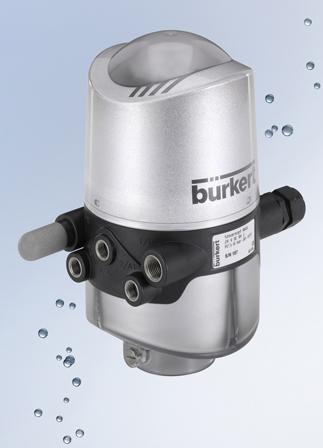
For auxiliary circuits such as steam, compressed air or cleaning media, the valve specialist Bürkert offers fluid control systems with the intelligent valve systems of the ELEMENT series for creating decentralised automation solutions. The latest addition to this solution portfolio is the new control head Type 8681, which was designed especially for use with pneumatically actuated hygienic media valves. The features of a decentralised automation solution in hygienic production processes can be used to good advantage not only in the auxiliary circuits, but throughout the plant at all process levels. In the planning of new plants, the use of conventional switch cabinets can be eliminated consistently. Existing plants can be converted from central to decentralised automation step-by-step, using the existing media valves.

New universal control head for hygienic process fittings
The Type 8681 control head is universally adaptable by means of adapters and can be combined with all commercially available valve types, such as flap valves, ball valves and single and double-seat valves, regardless of the manufacturer. Within the framework of a decentralised automation concept the control head, as a central unit for the hygienic process valves, performs all pneumatic actuation, feedback and diagnostic functions, as well as bus communication. Depending on the process valve, as many as three pneumatic driver chambers can be controlled separately.

The switching positions of the hygienic process valve are measured by the control head via an inductive analogue distance sensor for monitoring strokes of up to 85 mm and then transmitted to a master controller. After installation of the control head on the valve actuator the switching positions are automatically determined by a fast and reliable teach-in function, which eliminates the need for time-consuming manual configuration. If a fourth switching position is required, it can be read in by an externally mounted inductive proximity switch.

For optimal adaptation to the respective valve and process, the switching speed of each driver chamber can be set individually for both directions of movement by means of a restrictor function integrated in the pilot valve. In addition, a non-return valve prevents faulty switching of other driver chambers of the process valves due to back pressure. Independent of the power supply, each pilot valve can additionally be switched manually by means of a mechanical control. Thanks to a patented magnetically coded manual control, it is possible to switch the main actuator for maintenance purposes from outside even in the case of a completely enclosed device - ensuring full IP protection at all times.

A highly visible three-colour optical status display with high-power LEDs, which is integrated in the control head, provides for an optimum overview at the field level. In addition to electrical feedback to the master controller, it also signals the current switching position of the process valve, facilitating diagnosis and maintenance within the system itself. Diagnostic functions such as required maintenance or errors are likewise signalled visually and can be read out in detail via a service interface. This communication can be wireless via a Bluetooth module or via the integrated USB interface.


Hygienic control valves are also suitable for decentralised automation
The use of one of the positioners or process controllers of the ELEMENT series allows the decentralised automation of control valves, in addition to the process valves. The ELEMENT process controllers are optimised for cleaning and use in the wet areas of hygienic processing plants; their outer geometry, materials, surface quality and sealing properties comply with EHEDG guidelines. The compact positioners are installed directly on the pneumatic actuator to save space and require no external hoses, thanks to the internal control air supply. Installation and commissioning are facilitated by the use of intelligent positioners with automatic adaptation and process controllers with automatic control circuit detection and parameter optimisation. Communication is achieved via Profibus DPV1, Device NET or the AS-Interface.

One decentralised system solution for all process levels
With the addition of the new Type 8681 control head to the ELEMENT series, Bürkert now offers a complete product portfolio for decentralised process automation in food and beverage production, breweries and the milk processing and pharmaceutical industries. The range of products extends from the process valve with an integrated pilot valve, as well as electrical and simple optical feedback all the way to the decentralised control of aseptic, hygienic control valves by means of a control head and process controller in complex production plants. decentralised automation can therefore be used in all processes for entire plants and installations, enabling users from these industries to combine the requirements for hygiene and safety with a high degree of automation and efficiency. Since the new control head can be used with virtually all available fittings regardless of the manufacturer, there are practically no limits to decentralised automation with uniform standards.
 To download the Burkert ELEMENT Conrtrol Valves datasheet: click here
The new flow transmitters at a glance


  • Beautiful stainless steel housing in standardized ELEMENT design
  • Long durability and outstanding availability
  • Removable, programmable display with backlight
  • Programming via joystick
  • New processors and software
  • Future-proof system architecture
  • Protection class IP 65/67
  • Resistant to cleaning chemicals
  • Up to two 700 mA transistor outputs
  • Analog outputs 4-20mA
  • UL approved

To receive more information on Burkert Element Valves please contact Forberg Scientfic customer service:
Phone: 855-288-5330Email: mechanicalsales@forberg.com

Friday, July 29, 2011

BURKERT EXPANDS AESTHETIC CLEAN LINE ELEMENT RANGE WITH NEW ‘FUTURE-PROOFED’ STAINLESS STEEL DIGITAL FLOW TRANSMITTERS

News Release from: Burkert Fluid control Systems

Bürkert Fluid Control Systems has expanded its ELEMENT modular stainless steel range of products for total solutions in process measurement and control, with new Type 8026, 8036 and 8076 digital flow transmitters.


The new transmitters are robust (IP65/67 wash down resistant), aesthetic clean line products offering enhanced technical features such as future- proofed system architecture and software, removable programmable backlit displays, and simplified programming via joystick.


The ELEMENT flow transmitters are available in three configurations, Basic to Advanced, to meet all OEM and user budgetary requirements. The Basic unit has one 4-20mA and one NPN transistor output, while the most advanced unit has two NPN/PNP transistor outputs and two 4-20mA outputs. Importantly, both units comply with the stringent UL safety standards, and provide long-lasting and reliable ingress protection rated IP 65/67. In addition, the stainless steel housings of the flow transmitters are durable and resistant to cleaning chemicals, as well as enhancing the look of any system with their high-quality appearance. These features make the flow transmitters ideal not only for use in water treatment and process automation, but also in food and beverage, dairy, brewing, cosmetics and pharmaceuticals.


The Innovative operating concept of the ELEMENT series of flow transmitters includes removable displays that are programmable and equipped with backlighting for easier operation. All customer-specific settings, such as the measuring range, units of measurement, pulse output and filters are configured directly at the device. The programming itself is achieved via a joystick. By moving this unit horizontally and vertically, lines and rows are selected and activated; pressing the joystick to set the parameters, define and save configurations and to start the unit.


The clean line stainless steel housings of the ELEMENT series integrate a future-proof system and system architecture, with a new processor and new software to optimise the performance of the transmitter sensors. To guarantee maximum reliability and quality, the same circuits are used for conductivity and pH/ORP measurement as those used in Bürkert’s well proven ELEMENT transmitter models, Type 8222 and 8202.


Burkerts ELEMENT System:
Burkert’s new ELEMENT system sets a higher benchmark in process measurement and control. It provides a complete systems approach, linking clean line valves, sensors, positioners and valve actuators in a simple architecture to solve total control loop processes. With unlimited modularity, ELEMENT saves processing time by offering total control solutions for media from slurries to steam, and from de-ionized water to hydrochloric acid.

To download the Burkert ELEMENT Conrtrol Valves datasheet: click here
The new flow transmitters at a glance

  • Beautiful stainless steel housing in standardized ELEMENT design
  • Long durability and outstanding availability
  • Removable, programmable display with backlight
  • Programming via joystick
  • New processors and software
  • Future-proof system architecture
  • Protection class IP 65/67
  • Resistant to cleaning chemicals
  • Up to two 700 mA transistor outputs
  • Analog outputs 4-20mA
  • UL approved

To receive more information on Burkert Element Valves please contact Forberg Scientfic customer service:
Phone: 855-288-5330
Email: mechanicalsales@forberg.com


Tuesday, April 26, 2011

Burkert Newly Designed Angle-Seat Control Valve Announced

In line with Burkert's philosophy for modular valves and sensors the construction of the 2300 angle-seat valve fulfills tough criteria for process environments. Unrivalled cycle life and sealing integrity is guaranteed by the proven self-adjusting packing gland. the parabolic trim provides excellent control characteristics and flow rates approximately 35% larger than conventional control valves. It is available in either stainless steel on stainless steel or with a durable PTFE seal for tight shut-off.

The design enables the easy integration of automation modules whether they are digital electro-pneumatic positioner or process controller. The fully integrated system (part of Burkert's new Element line ) has a compact and smooth design, integrated pneumatic lines, IP65/67/NEMA4X protection class and superior chemical resistance. This system has been engineered for reliable accurate control in applications where high flow rate is an advantage. It's clean stainless steel design makes it optimal for use in hygienic environments.

Call your Forberg Scientific Sales Professional Toll Free: 855-288-5330 or email mechanicalsales@forberg.com

Burkert Element PDF