Showing posts with label parker. Show all posts

Monday, September 29, 2014

Parker Veriflo ChangeOver System

ChangeOver System
Continuous Gas Management


Customer Value Proposition:

The ChangeOver System is a compact turnkey module that assists the operator with their total gas management. The COSE maintains a continuous gas delivery from two separate sources allowing for maximum cylinder gas usage from one source before automatically switching to the second source. The COSE lowers speciality gas costs by maximizing the consumption of gas from each cylinder. In addition, the gas cylinder bank(s) can be monitored remotely utilizing the optional pressure switches reducing the need for visual inspection by the operator.

Product Features:
• Fully enclosed to protect internal components
• Removable side panels for field maintenance
• Allows change out of depleted cylinder(s) while maintaining gas flow
• Especially suited for continuous on-stream analyzers
• Alarm sensor port for systems integration allowing user to monitor gas consumption
• Cleaned for Oxygen service
• Regulator design integrates positive upward and downward stops which increases cycle life by preventing over stroking of the diaphragm

Parker Veriflo ChangeOver System Applications

Specialty Gases
All Specialty Gases used for Process and Purging Applications

Industrial/Analyzer

  • Refineries
  • Test Cells
  • Emission Analysis
  • Laboratories
  • Laser Gas Systems
  • Research and Development
  • Gas and Liquid Chromatography
  • High Volume Gas Manufacturing Facilities

If you would like to receive more information, pricing and availability on the Parker Veriflo ChangeOver System or other Parker Veriflo products please contact Forberg Scientific customer service.
Toll Free: 855-288-5330
Email: mechanicalsales@forberg.com


Wednesday, April 30, 2014

How To Identify Fitting Threads

We are frequently asked to explain the differences in various types of threads, as piping specifications and (or) equipment are designed with the following threaded connections:
  1. NPT
  2. BSPT
  3. BSPP
  4. Screw Thread
  5. S.A.E. Straight Thread
  6. Metric Thread
 

NPT Thread

 
NPT, National Pipe Thread or pipe taper is the most commonly used pipe thread in the United States and Canada.
 
Figure 1 NPT (National Pipe Taper)

Characteristics of NPT

  1. Thread Pitch measured in inches.
  2. Root & Crest Truncation are flat.
  3. 60° Thread Angle
  4. Taper Angle 1° 47’
 
Parker’s Instrumentation Products Division machines this thread on all CPI™, A-LOK® as well as on pipe & pipe adapter fittings where N.P.T. is designated. All male threads are rolled for strength and durability. Parker IPD’s NPT threads meet the standards set forth by ANSI B 1.20.1  

BSPT - British Standard Taper

Figure 2 BSPT
  
Characteristics of BSPT
  1. Taper Angle 1° 47’
  2. 55° thread angle
  3. Pitch can be measured in millimeters or inches
  4. Thread truncation is round
  5. BSPT threads are different from and will not substitute for N.P.T.
  6. threads.
 
The following standards are equivalent to B.S.P.T.
  • ISO 7/1 (International Standards Organization)
  • DIN 2999 (Deutsche Industrial Norme)
  • JIS B0203 (Japanese Industrial Standard)
  • d. BS 21 British Standard
BSPP - British Standard Parallel Pipe
 
Form A
A self centering taper is used at the hex which centers a “Bonded” washer (usually metal and elastomer) to seal to the surface surrounding the female thread.
Form B
A metal gasket (usually copper) performs the
seal between the face of the body and the face of the female threaded component. For Form “B” replace “R” in P/N with “BR”.
 

Characteristics of BSPP

  1. 55° thread angle
  2. Thread pitch measured in inches
  3. Thread diameter measured in inches
  4. Root/Crest Truncation round
 
A parallel thread form uses the threads for holding power only and seals by means of an O-ring and retainer ring.
 
The following standards are equivalent to B.S.P.P.
  1. ISO 228/1 (International Standards Organization)
  2. DIN 3852 Part 2 & Parallel threads (Deutsche Industrial Norme)
  3. JIS B0202 (Japanese Industrial Standard)
  4. BS 2779 (British Standard)
 

Unified Screw Threads


These are very common threads utilized on valves and fitting stems, nut and fitting end threads. They are straight, NOT tapered threads used for holding power.
 
Figure 4
 
Screw threads are denoted by the following:
For instance: 5/16                -          20
                      Thread Diameter       Number of Threads per inch
 
In general - screw threads can be further classified into various types of pitch’ (UNF) Unified Fine Pitch - (UNC) Unified Coarse - (UN) Unified Constant.
 
These classifications are determined by the relationship of threads per inch to outer diameter.
 
Note: For further information on thread pitch, please refer to ISO standards handbook or H-28 handbook.
 

SAE Straight Thread Port (SAE J1926)

 
Parker straight thread fittings shown are for connection with the SAE straight thread port as shown here. Basic port dimensions are give in Fig. 5 below. This port is the same as MS16142. It is also similar to, but dimensionally not the same as MS 33649 and AND 10050.


Figure 5 SAE Straight Thread O-ring Port Dimensions
 
 
NOTE: Tap drill lengths “P” given here require bottoming taps. Increase “P” as required for standard taps.
 
NOTE: Diameter “U” shall be concentric with thread pitch diameter within .005 FIM. It should be free from longitudinal and spiral tool marks.
 

Metric Threads (ISO 6149-2)


The following sections were prepared with the intention of explaining that NONE of them should be confused with a metric thread.
 
Please remember that a metric thread, be it parallel or tapered is designated as metric by the distance in millimeters from thread crest to crest. In the case of the parallel thread Figure 6 the O.D. is also expressed in millimeters.
 
Figure 6
 
To assist you in determining the various types of threads, Parker has available the International Thread I.D. Kit/Bulletin 4303-B1. It includes calipers, international and screw thread pitch gauges.
 
If you would like to receive more information about Parker A-Lok, Parker CPI or Parker Pipe Fittings please contact the Forberg Scientific Mechanical Sales Team
Phone: 248-288-5330

Tuesday, June 5, 2012

Balston NitroFlow 60 LC/MS Membrane Nitrogen Generator

Haverhill, MA, May 30, 2012 – The Filtration and Separation Division of Parker Hannifin Corporation, the global leader in motion and control technologies, has introduced the Parker Balston NitroFlow 60 LC/MS Membrane Nitrogen Generator.

The Parker Balston NitoFlow 60 is a self-contained nitrogen generator capable of producing up to 60 slpm of pure LC/MS grade nitrogen at pressures of up to 110 psig. This system is ideal for multiple LC/MS and new LC/MS instruments requiring high flow. The output flow produced by the NitroFlow 60 is equivalent to using one cylinder of compressed gas every two hours.

Nitrogen is produced utilizing a combination of a scroll compressor and nitrogen membrane separation technologies. This combination of technologies yields the highest performing, most quiet, and reliable integrated nitrogen generation system available.

If you would like to receive more information about Parker Balston Membrane Compressed Air Dryers or other Parker Balston Products please contact Forberg Scientific customer service.
Phone: 248-288-5330
Email: mechanicalsales@forberg.com

Wednesday, May 23, 2012

Parker Balston Membrane Compressed Air Dryers Exemption from EU ATEX Directive

Parker Balston Membrane Compressed Air Dryers Receive Exemption from EU ATEX Directive

Haverhill, MA, May 21, 2012 - The Filtration and Separation Division of Parker Hannifin Corporation, the global leader in motion and control technologies, is pleased to announce that Parker Balston Membrane Compressed Air Dryers are exempt from the EU ATEX Directive.

According to the Hazardous Locations Product Team of CSA International, “The Membrane Dryer products are not required to meet the EU ATEX Directive. The product is non-electrical with no moving mechanical components. The air movement within the product is not likely to produce static as an ignition hazard…There is not enough energy around to cause an ignition.”

Parker Balston Membrane Air Dryers offer the unique ability to lower a compressed air stream’s dewpoint without electricity or moving parts permitting use in flammable and hazardous environments where explosions or fires are a concern.

The drying system produces a dewpoint of -40°F (-40°C) and lower while removing all other compressed air contaminants 0.01 micron in size and larger. The system utilizes sophisticated technology to dehydrate the air without the need of electricity. The wall mountable air dryers can be easily configured and are ideal for space constrained. Unsurpassed in performance and durability to dehydrate and purify compressed air, Parker Balston Membrane Air Dryers significantly outperform conventional air filtration. Prefilters, membrane, modules and mounting brackets are included with the system.

If you would like to receive more information about Parker Balston Membrane Compressed Air Dryers or other Parker Balston Products please contact Forberg Scientific customer service.
Phone: 248-288-5330
Email: mechanicalsales@forberg.com

Tuesday, March 13, 2012

Parker Fitting Assembly & Remake Instructions


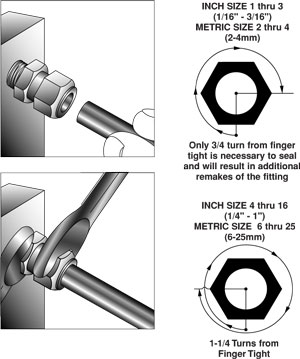
1. Parker instrument tube fittings are sold completely assembled and ready for immediate use. Simply insert the tube as illustrated until it bottoms in the fitting body. (If the fitting is disassembled, note that the small tapered end of the ferrule(s) go into the fitting body.)

2. Tighten nut finger tight. Then tighten nut with wrench an additional 3/4 or 1-1/4 turns indicated at left. Hold Parker fitting body with a second wrench to prevent body from turning. It is helpful to mark the nut to facilitate counting the number of turns.

For maximum number of remakes, mark the Parker fitting and nut before disassembly. Before retightening, make sure the assembly has been inserted into the fitting until the ferrule seats in the fitting. Retighten the nut by hand. Rotate the nut with a wrench to the original position as indicated by the previous marks lining up. (A noticeable increase in mechanical resistance will be felt indicating the ferrule is being re-sprung into sealing position.)

Only after several remakes will it become necessary to advance the nut slightly past the original position. This advance (indicated by B) need only be 10° - 20° (less than 1/3 of a hex flat).

Parker A-Lok/CPI® Tube Fitting part numbers use symbols to identify the size, style, and material. Tube and pipe thread sizes begin with a number indicating their size in sixteenths of an inch. For example, 4=4/16” or 1/4”; 16=16/16” or 1".
NOTE: Lubrication on the nut is REQUIRED for proper assemblyon all LARGER size fittings in both inch and metric sizes.  This requirement applies to:
  • inch sizes of 20 and higher
  • metric sizes of 25 and higher
Gaugeability Instructions*


1. From “finger tight” position, wrench 1-1/4 turns for 1/4" to 1" size fittings (6mm to 25mm) (1/16", 1/8", 3/16", 2mm, 3mm and 4mm size tube fittings only wrench 3/4 turn from finger tight position). Hold fitting body hex with second wrench to prevent body from turning as you tighten. It is a good idea to mark the nut (scribe or ink) to help you count the turns.


2. Now select the proper size inspection gauge and try to place it, as shown, between the nut and the body hex. If gauge DOES NOT FIT AT ANY POINT between them, you have correctly tightened the nut. If you can slip the gauge into the space, the fitting is not properly made up, and you must repeat the assembly procedure.
*For initial make up only.


If you would like more information about Parker A-lok/ CPI Instrumentation Tube Fittings or other Parker Products please contact Forberg Scientific Inc Customer Service.
Toll Free: 855-288-5330
Email: mechanicalsales@forberg.com

Monday, March 12, 2012

Cost-Effective Solution for Industrial Instrumentation Applications

Parker’s New Carbon Steel Hand Valves and Manifolds Offer a Cost-Effective Solution for Industrial Instrumentation Applications

 Parker Hannifin Corporation is now offering hand valves and two-, three- and five-valve manifolds in carbon steel, a more economical material than stainless steel. Developed by Parker's Instrumentation Products Division (IPD), the new series provides an ideal solution for natural gas transmission lines, as well as other chemical/petrochemical and power industrial instrumentation applications that don't require the extreme performance of stainless steel.

The new carbon steel hand valves and manifolds are pressure-rated up to 6,000 psig (414 bar) to provide system flexibility when selecting process valves for a variety of applications. They are designed to work with Parker's industry-leading A-LOK® and CPI™ fittings, as well as other manufacturers' products. An external adjustable gland allows for full adjustment of the stem packing without removal of the valve from the system. Handles are color-coded to quickly and easily identify valve functions – including test/drain, equalize, and isolate – thereby avoiding errors and increasing safety.
"Our new carbon steel hand valves and manifolds meet a clear customer need by providing a cost-effective option for applications that don't demand the extreme performance of steel," commented Kevin Burke, Parker IPD Marketing Manager. "Additionally, local assembly and testing in Texas mean customers can count on receiving excellent customer service and product availability."
Catalogs
Catalog 4190-HV (hand valves)
Catalog 4190-PM (two-valve manifolds)
Catalog 4190-FM (three- and five-valve manifolds)
For more information regarding Parker's new carbon steel hand valves and manifolds or other Parker Instrumentation products please contact Forberg Scientific customer service. 
Toll Free: 855-288-5330

Wednesday, February 22, 2012

Flow Meter Versatility for Industrial Applications Porter P-Series

Parker's New P-Series Flow Meters Deliver Greater Application Versatility For Industrial Customers
The Porter Instrument Division of Parker Hannifin, the global leader in motion and control technologies, has unveiled the expanded P-Series variable area flow meter product line, an all-new range of flow meters that provides significantly greater application versatility for industrial applications. The expanded P-Series offering enhances Parker’s existing rotameter product line in acrylic, glass and metal tube flow meters. The new products are designed to accommodate greater flow rates, temperatures and environmental conditions.

The P-Series line extension gives customers more choice when sourcing flow measurement and control devices in applications such as oil and gas production, food manufacturing, power generation, chemical and petrochemical, and pharmaceutical manufacturing. The new variable area product line expands the Porter Instrument flow meters range to include:

  • Gas flows up to 350 sft3/m (9910 slpm) of air
  • Liquid flows up to 450 US gpm (1700 lpm) of water
  • Pressures up to 4000 psig (275 Bar)and higher (on special request)
  • Temperatures up to 575o F (300o C) and higher (on special request)
  • NEMA and IP enclosures for weatherproof applications
  • Intrinsically safe transmitter and alarm options
  • Certified calibrations conforming to ISA RP 16.6, NIST traceable
  • High accuracy and repeatability
  • An extensive selection of materials of construction and elastomeric seals to suit a wide range of gases, fluids and environmental conditions
This new line extension, coupled with the Porter Instrument reputation for responsive support and on-time delivery, will give customers the greater product range they need along with the superior service they have come to expect from a world class provider.

The
Porter Instrument Division specializes in the development, manufacture and sale of precision instruments for the measurement and control of gases and liquids. Porter Instrument flow and pressure control instruments, both standard or modified to customer design requirements, excel in some of the world's most performance-critical applications. They play a vital role in the production of computer chips; they are trusted for the regulation and measurement of anesthetic gases in operating rooms worldwide; and they aid in the production of pharmaceutical drugs, cutting-edge biotech research, dental patient sedation and environmental monitoring, among many other applications.

If you would like more information about Porter Instrument P-Series flow meters or other Porter Instrument products please contact Forberg Scientific, Inc. customer service.
Toll Free: 855-288-5330
Email: mechanicalsales@forberg.com

Thursday, June 23, 2011

Parker Veriflo Moblie App

Parker Veriflo is please to announce the launch of their new Mobile App.  This App provides easy access to all Veriflo Product Catalogs and specifications "on-the-go" through you mobile browser.


Highlight of App:
  • Can beviewed on iPhone, iPad, iTouch, Android phones and all devices that have Safari or Google Chrome browsers.
  • Clean interface for easy navigation to all our products quickly
  • Email product catalogs
  • Configure product model numbers.
  • And all other convenient features of having a mobile device.
Please enter http://m.parker.com/veriflo to access this app on your mobile device's web browser.

Thursday, June 16, 2011

Parker Tube Fittings Installation Instructions


Forberg Scientific Inc. is a Parker Instrumentation Solution Center. For more than 40 years Forberg has been a leader in instrumentation and the industrial distribution field. Forberg Scientific is a distributor / manufacturer's representative organization with a passion for customer service and innovative problem solving.

Forberg Scientific Inc. offers Parker A-lok & Parker CPI Instrumentation Tube Fittings that are designed as leak-free connections for process, power and instrumentation applications. These world renowned fittings are manufactured to the highest quality standards and are available in a broad range of sizes, materials and configurations.

You can find Parker Tube Fittings and a large variety of other product lines we offer at www.forberg.com .
email: mechanicalsales@forberg.com

Thursday, April 14, 2011

Advantages of Parker CPI Single Ferrule Instrumentation Tube Fittings vs Swagelok type

Advantages of Parker CPI single ferrule instrumentation tube fittings over dual ferrule (Swagelok - type) tube fittings.


Safety - By reducing chances for error, chances for leaks are reduced.


Simplicity - By design, Parker CPI single ferrule tube fittings are easier to work with than dual-ferrule instrumentation tube fittings like (Swagelok).


Service Life - The Parker CPI moly-impregnated stainless steel nut provides more remakes and less thread galling versus silver coated threads used in two-ferrule designs like (Swagelok).


Interchangeability - Parker CPI single-ferrules are fully interchangeable with Swagelok dual-ferrule systems and can be used in either Parker or Swagelok fitting bodies.


Check out the Parker CPI Advantage .pdf